A Cosmic Visitor from Beyond
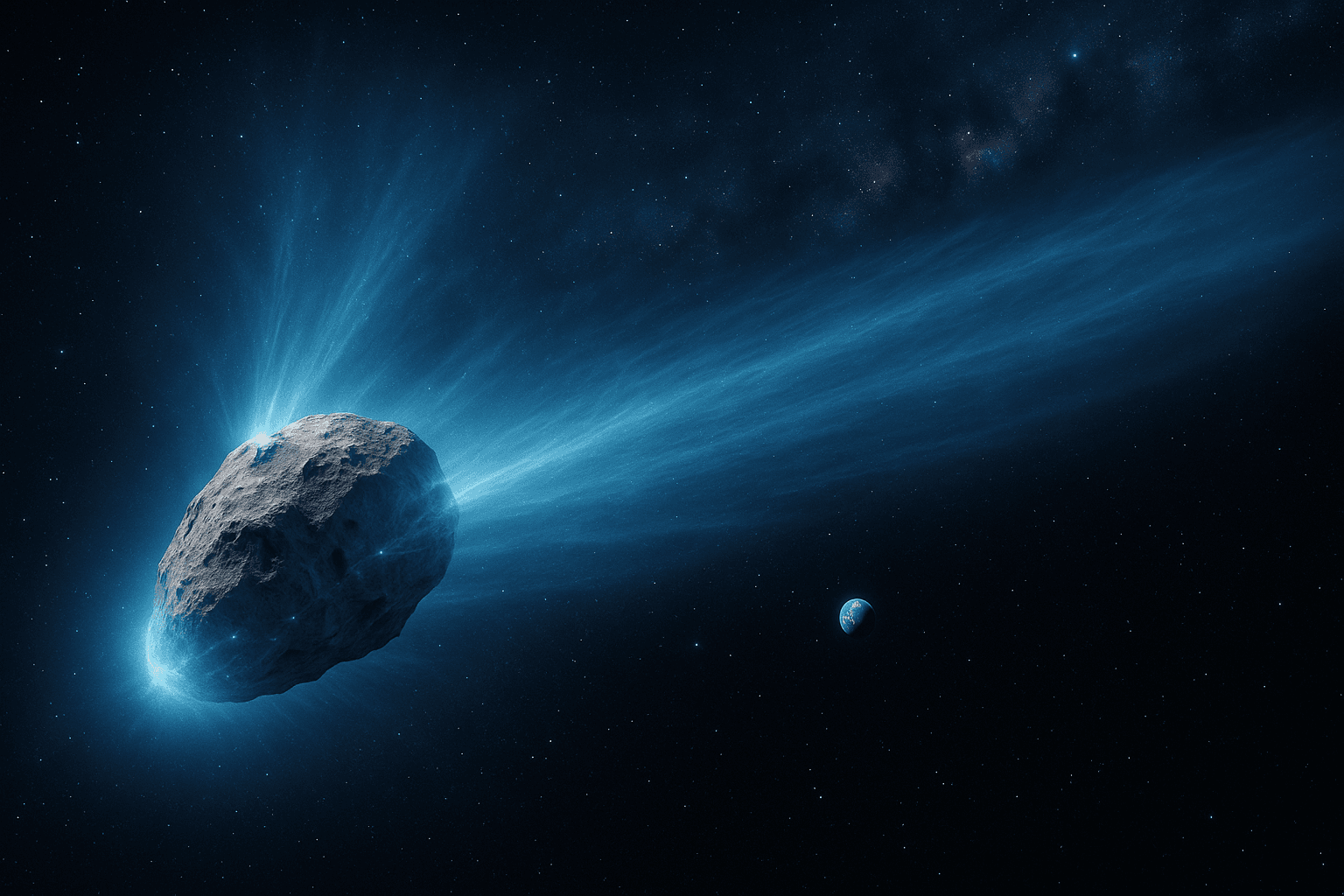
3I/ATLAS stands as only the third confirmed interstellar object ever detected, following 'Oumuamua and 2I/Borisov. But this ancient wanderer carries something far more significant than its predecessors: clear evidence of complex organic chemistry that could fundamentally change how we understand life's origins.
On December 19, 2025, 3I/ATLAS will reach its closest approach to Earth at 269 million kilometers. The timing is remarkably fortunate—the encounter coincides with a new moon phase, providing optimal observation conditions for telescopes worldwide.
This isn't just another astronomical event. 3I/ATLAS represents a rare opportunity to study pristine materials from another star system, materials that may contain the chemical blueprints for life itself. Unlike comets born in our solar system, this visitor has traveled through interstellar space for millions of years, preserving conditions from its ancient birthplace.
Scientific Evidence: What We've Discovered
The evidence from 3I/ATLAS is already reshaping our understanding of interstellar chemistry. Multiple observatories have confirmed remarkable findings that distinguish this object from typical solar system comets.
Key Points
- Hubble Space Telescope observations reveal a distinctive bluish coma composition unlike any known solar system comet
- European probe Jis detected intense plasma and dust tails indicating active sublimation
- ALMA Chile identified methanol and hydrogen cyanide molecules in the coma
- Confirmed mass loss patterns match theoretical models for interstellar object solar heating
The bluish coloration observed by Hubble suggests unique chemical processes occurring as solar radiation interacts with the comet's nucleus. This distinctive signature provides a fingerprint of conditions in the object's original star system, potentially billions of years old.
Most importantly, the detection of methanol (CH₃OH) and hydrogen cyanide (HCN) represents the first confirmed identification of complex organic molecules in an interstellar visitor. These aren't just random chemicals: they're fundamental building blocks of life chemistry.
The Life Connection: Panspermia Evidence
The organic molecules detected in 3I/ATLAS provide compelling support for the panspermia hypothesis: the theory that life's ingredients travel between star systems on interstellar objects like comets and asteroids.
Methanol and hydrogen cyanide aren't just interesting chemicals: they're precursors to essential biological molecules. Methanol can react with other compounds to form amino acids, while hydrogen cyanide is a key ingredient in nucleotide synthesis, the building blocks of DNA and RNA.
These molecules create favorable conditions for life development through several mechanisms:
- Catalytic reactions: Methanol acts as a solvent and reactant in organic synthesis
- Energy storage: HCN can form polymers that store and release chemical energy
- Protective environments: Organic compounds can shield developing life chemistry from radiation
Comparison Point: Earth-based comets and meteorites also contain organic compounds, but 3I/ATLAS carries these molecules from an entirely different stellar environment, suggesting that life chemistry may be universal across star systems.
The discovery proves that complex organic chemistry can survive the harsh conditions of interstellar space, maintaining molecular integrity across vast distances and time scales.
Future Research Opportunities
The scientific community is preparing for an unprecedented observation campaign as 3I/ATLAS approaches its closest point to Earth. Multiple advanced instruments will focus on the comet simultaneously, creating the most comprehensive study of an interstellar object ever conducted.
Upcoming Observations Include:
- James Webb Space Telescope infrared spectroscopy during closest approach
- Continued monitoring by ground-based observatories for months after December 2025
- 2026 Jupiter flyby observations via the Juno probe's extended mission
- Coordinated international telescope networks tracking molecular evolution
The Webb telescope's unprecedented sensitivity could reveal additional organic molecules currently below detection thresholds. Its infrared capabilities will penetrate the dust coma to observe the nucleus directly, potentially resolving questions about the object's internal structure and composition.
The 2026 Jupiter encounter offers another crucial observation window. As 3I/ATLAS passes through Jupiter's magnetosphere, interactions between the comet's plasma tail and the planet's magnetic field could reveal details about the object's electrical properties and internal structure.
Ancient Origins: A Window into Cosmic History
Evidence suggests 3I/ATLAS originates from a planetary system significantly older than our own solar system. The comet's chemical composition reflects formation conditions that existed when the universe was younger and stellar metallicity was different from today's standards.
This ancient heritage provides unique insights into early cosmic chemistry. The organic molecules we detect today were likely synthesized in the primordial disk around a star that formed billions of years ago, when galactic conditions were markedly different from the present era.
What This Reveals About Early Universe Conditions:
- Lower stellar metallicity affected organic molecule formation pathways
- Different radiation environments influenced chemical preservation
- Varied planetary system architectures affected comet ejection mechanisms
- Alternative stellar evolution patterns shaped organic chemistry development
Implications for Life: If life chemistry was already developing in stellar systems billions of years ago, the timeline for life's emergence in the universe may be far longer than previously thought.
The study of 3I/ATLAS essentially provides a fossil record of ancient cosmic chemistry, preserved in pristine condition by the cold vacuum of interstellar space.
Scientific Impact and Future Implications
3I/ATLAS represents a watershed moment for astrobiology and our understanding of life's potential cosmic origins. The confirmed presence of complex organic molecules in an interstellar visitor validates decades of theoretical work on panspermia and interstellar chemistry.
Confirmed Findings vs. Ongoing Questions:
Confirmed: Complex organic molecules survive interstellar travel
Confirmed: Ancient stellar systems produced life-relevant chemistry
Ongoing: Whether these molecules remain biochemically active
Ongoing: How common such chemistry is among interstellar objects
The broader significance extends beyond a single comet. 3I/ATLAS proves that the universe has been conducting organic chemistry experiments for billions of years, distributing the results via interstellar wanderers like cosmic seed ships.
This discovery will influence how we search for life beyond Earth. If organic molecules routinely travel between star systems, then life itself might be more interconnected across the galaxy than we ever imagined. The chemical ingredients for biology aren't confined to individual solar systems—they're part of a vast galactic mixing process.
Take action now: Follow upcoming observations of 3I/ATLAS as it reaches its closest approach to Earth. This ancient messenger from another star system could be carrying the most important scientific discovery of our lifetime—proof that life's chemistry is truly universal, and that we're part of a cosmic biological community that spans the stars.
