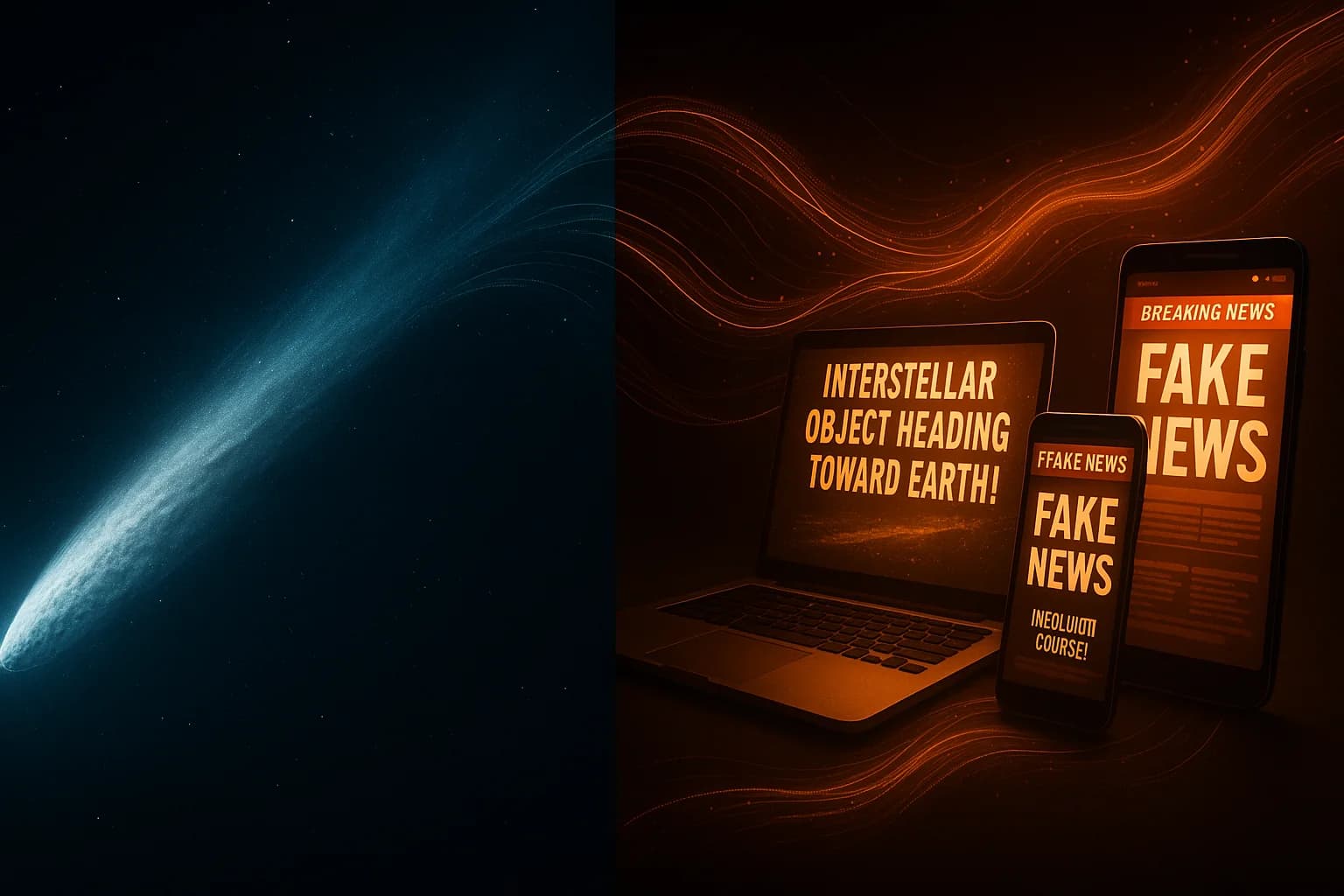
When False Claims Go Viral
"China confirmed 3I/ATLAS remained practically motionless in space." This shocking claim swept across the internet just a few days ago, suggesting that our mysterious interstellar visitor had somehow defied physics and stopped dead in its tracks near Jupiter's orbit.
The story spread like wildfire across multiple websites, social media platforms, and astronomy forums. Thousands of readers shared the "discovery" without questioning its validity. But here's the problem: it was completely fabricated.
3I/ATLAS, an interstellar object that entered our solar system from beyond Pluto's orbit, became the center of one of the most successful pieces of astronomical misinformation in recent memory. This case study reveals exactly how fake space news spreads and why critical thinking is essential when consuming scientific content online.
Dissecting the Fabricated Story
The false claim followed a familiar pattern of sophisticated misinformation. According to the fabricated reports, China's National Space Administration had supposedly conducted "weeks of analysis" showing that 3I/ATLAS had experienced "extreme deceleration" and was now "practically motionless" in space.
The story appeared simultaneously across multiple websites with nearly identical text. This copy-paste journalism approach is a red flag indicating unverified content spreading without independent fact-checking.
Key Points
- False claim: 3I/ATLAS "stopped" near Jupiter's orbit after extreme deceleration
- Attributed to China's National Space Administration without proper sourcing
- Identical text appeared across multiple websites simultaneously
- No independent verification or cross-referencing with official sources
The fabricated story even included technical-sounding details about orbital mechanics and gravitational analysis, lending it an air of scientific credibility that made it particularly convincing to casual readers.
The Source Verification Reality Check
When subjected to basic fact-checking, the claims crumbled immediately. A simple visit to the official Chinese Space Agency website revealed no dedicated section about 3I/ATLAS, no recent updates about interstellar object monitoring, and certainly no announcements about mysterious deceleration events.
This stark contrast with NASA's approach was telling. While NASA maintains comprehensive coverage of 3I/ATLAS with regular bulletins, detailed observations, and publicly accessible data, Chinese space authorities showed minimal interest in the object. Their last official mention occurred on November 8th: a brief Tianwen-1 orbiter image with little accompanying analysis.
Critical Verification Step: Always check official space agency websites directly. If a major astronomical discovery isn't featured prominently on NASA, ESA, or the relevant national space agency's official channels, treat the claim with extreme skepticism.
The logical explanation for this disparity is straightforward: space agencies typically invest resources in covering discoveries they contributed to making. Since 3I/ATLAS was discovered by Western telescopes, Chinese authorities had little incentive to conduct extensive independent analysis.
The Physics of Why Objects Don't Just 'Stop'
Beyond the sourcing problems, the claim failed basic physics scrutiny. Objects traveling at 3I/ATLAS's velocity (approximately 30 kilometers per second) cannot simply "stop" in space without catastrophic consequences or massive external forces.
As space science expert Sacani noted in response to similar claims, such an event would be catastrophic and immediately detectable by observatories worldwide. The energy required to decelerate an interstellar object of 3I/ATLAS's estimated mass would produce observable signatures across multiple wavelengths of electromagnetic radiation.
The reality is far less dramatic: 3I/ATLAS continues following its predicted trajectory, maintaining expected speeds as it responds predictably to gravitational influences from the Sun and planets. Recent observations confirm the object is behaving exactly as orbital mechanics equations predict for a body of its characteristics.
The Broader Impact on Science Communication
This misinformation incident represents a larger pattern affecting astronomical news. Sensational claims about space objects regularly spread through networks of websites that prioritize click-generating headlines over scientific accuracy.
The consequences extend beyond mere entertainment. When false claims go viral, they:
- Distort public understanding of how space science actually works
- Undermine trust in legitimate astronomical discoveries
- Create confusion about reliable sources of scientific information
- Generate skepticism toward real breakthrough observations
Protect Yourself: Before sharing astronomical news, verify it through official sources like NASA, ESA, or peer-reviewed journals. Extraordinary claims require extraordinary evidence from credible institutions.
The 3I/ATLAS "stopping" hoax succeeded because it combined technical-sounding language with attribution to a space agency, creating an appearance of legitimacy that bypassed many people's critical thinking filters.
Your Defense Against Space Misinformation
The case of 3I/ATLAS's fake "stopping" offers valuable lessons for consuming space news responsibly. This particular false claim was easily debunked through basic verification steps that anyone can perform.
Here's your action plan: Before believing or sharing astronomical claims, spend two minutes checking official space agency websites. Look for peer-reviewed publications. Verify that multiple independent sources are reporting the same findings. If a "discovery" appears only on obscure websites with identical text, treat it as fiction until proven otherwise.
Remember that extraordinary claims require extraordinary evidence from credible sources. Real astronomical breakthroughs involve multiple observations, peer review, and extensive verification before announcement. The universe is amazing enough without fabricated stories making it seem even stranger.
Take action: The next time you encounter a sensational space story, apply these verification techniques. Help combat misinformation by refusing to share unverified claims and encouraging others to check their sources. Science deserves better than copy-paste journalism and fabricated discoveries.
