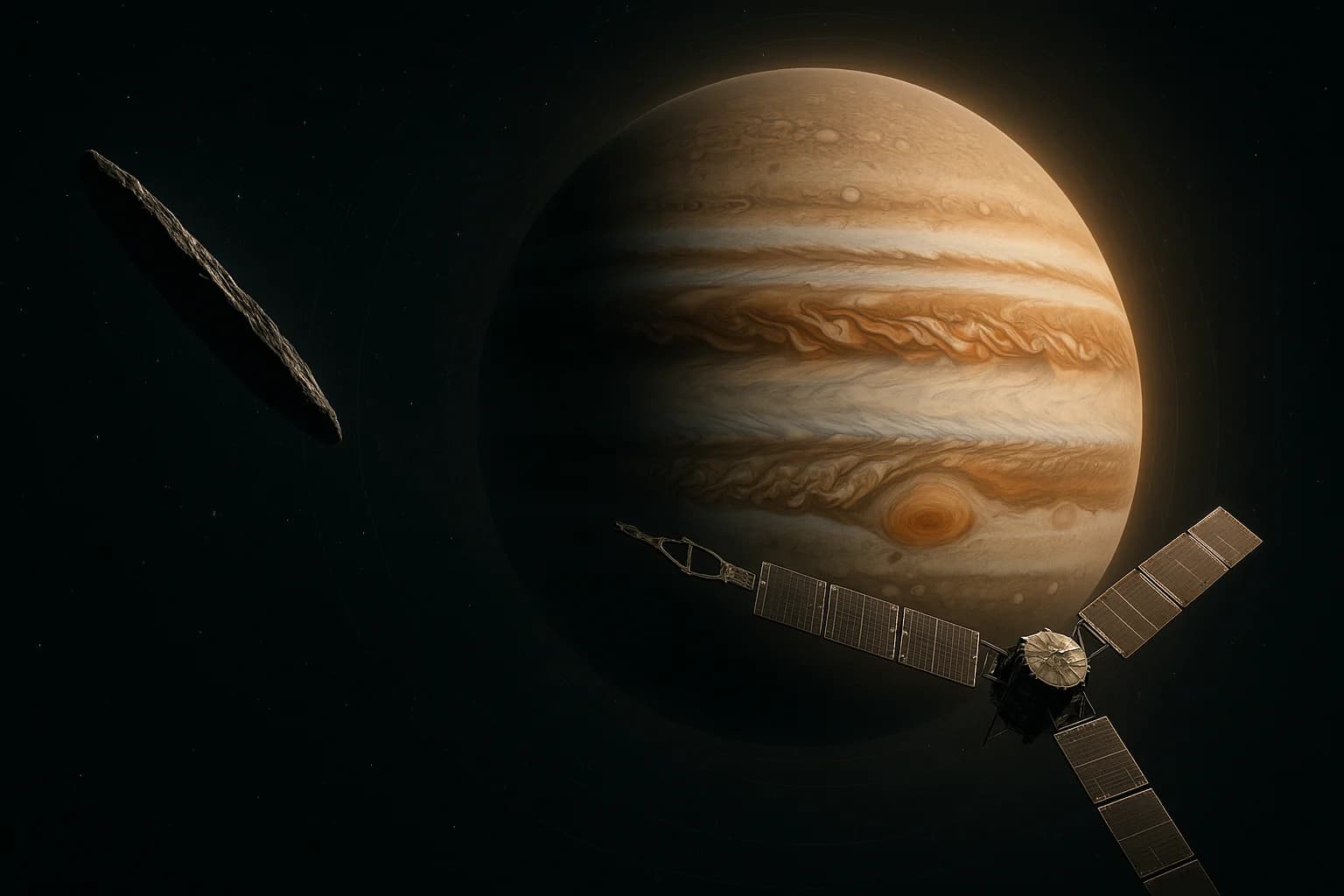
The Mystery of 3I/ATLAS
An interstellar visitor is heading toward Jupiter with a trajectory so precise it's raising unprecedented questions about whether we're witnessing natural celestial mechanics or something far more extraordinary. 3I/ATLAS, the third confirmed interstellar object to enter our solar system, has become the center of a scientific controversy that touches the very foundations of our understanding about life beyond Earth.
Unlike 'Oumuamua, which vanished before proper study, 3I/ATLAS is providing scientists with months of observation time. What they're discovering challenges conventional explanations. The object's path toward Jupiter isn't just unusual: it appears to target one of the most significant boundaries in planetary science with mathematical precision that seems almost impossible for a natural comet.
In March 2026, NASA's Juno probe will conduct the most detailed observations ever attempted of a potentially artificial interstellar object, measurements that could finally answer the question haunting the astronomical community.
The Puzzling Trajectory Revisions
NASA has repeatedly revised its calculations of 3I/ATLAS's non-gravitational acceleration, each time making the numbers smaller. The original estimates suggested powerful outgassing typical of active comets, but subsequent observations revealed something puzzling: the acceleration was tens of times weaker than initially calculated.
Key Points
- Original non-gravitational acceleration estimates revised downward by factors of 10-50
- Current values suggest minimal outgassing compared to typical comets
- Trajectory precision increases with each revision, making Jupiter encounter more remarkable
- Weak acceleration cannot explain the precise targeting of Jupiter's Hill sphere boundary
This pattern of downward revisions matters because it makes 3I/ATLAS's trajectory toward Jupiter increasingly precise. Natural comets experience random pushes from sublimating ice that typically scatter their paths. The weaker these forces become, the more intentional 3I/ATLAS's course appears.
The scientific explanation for typical cometary behavior involves volatile materials vaporizing as objects approach the Sun, creating jets that alter trajectories unpredictably. 3I/ATLAS shows minimal such activity, yet maintains a course that seems almost navigated.
The Hill Sphere Coincidence
Jupiter's Hill sphere represents the boundary where the planet's gravitational influence dominates over the Sun's. This invisible sphere, extending about 53 million kilometers from Jupiter, is crucial for understanding orbital dynamics and spacecraft navigation. What makes 3I/ATLAS extraordinary is its apparent precision in approaching this exact boundary.
Hill Sphere Definition: The region around a planet where its gravity dominates over the central star's influence. Objects within this sphere can maintain stable orbits around the planet rather than the star.
Statistical analysis reveals the improbability of such precision occurring naturally. For a comet from another star system to randomly target this specific gravitational boundary represents odds so astronomical that many scientists are reconsidering what they're observing.
Natural objects following gravitational trajectories don't typically demonstrate such mathematical precision. Spacecraft do. Every human probe sent to the outer planets has been carefully designed to approach or utilize Hill sphere boundaries for gravitational assists and orbital mechanics.
The question haunting researchers: is this remarkable precision evidence of artificial navigation, or are we witnessing an extraordinary cosmic coincidence?
Loeb's Spacecraft Hypothesis
Harvard astrophysicist Avi Loeb proposes that 3I/ATLAS's trajectory makes perfect sense if viewed as a technological artifact. Hill sphere boundaries represent ideal locations for deploying secondary probes because Jupiter's gravity can provide natural acceleration for smaller objects sent toward inner planets.
This concept isn't science fiction: NASA routinely uses gravitational assists to accelerate spacecraft and change their trajectories. The Voyager probes, Cassini, and countless other missions have demonstrated how planetary gravity wells can be leveraged for efficient space travel.
If 3I/ATLAS is artificial, its approach to Jupiter's Hill sphere boundary would allow it to:
- Deploy smaller reconnaissance probes toward Mars or Earth
- Use Jupiter's gravity for course corrections without fuel expenditure
- Position itself for optimal observation of the inner solar system
- Establish a staging area for extended exploration
Critics argue that natural explanations exist for unusual trajectories, pointing to the complex gravitational interactions possible in multi-body systems. However, none satisfactorily explain the mathematical precision of 3I/ATLAS's approach to this specific boundary.
The Ultimate Test: March 2026
NASA's Juno probe, currently orbiting Jupiter, will conduct unprecedented observations during 3I/ATLAS's closest approach in March 2026. These measurements represent our best opportunity to distinguish between natural and artificial origins through direct observation.
Key Points
- Juno's instruments will measure 3I/ATLAS's composition, structure, and electromagnetic signatures
- High-resolution imaging could reveal surface features indicating natural or artificial construction
- Magnetometer readings might detect metallic components or technological signatures
- Precise trajectory measurements will determine if course corrections occur
Specific observations that could support artificial origins include geometric regularity in surface features, electromagnetic emissions consistent with technology, or evidence of controlled trajectory adjustments. Natural origins would be supported by irregular rocky composition, random outgassing patterns, and purely gravitational motion.
Timeline Critical: The March 2026 observation window represents a unique opportunity. 3I/ATLAS will be close enough for detailed study but distant enough to observe safely, conditions unlikely to repeat for any interstellar visitor.
The implications extend far beyond one mysterious object. These observations will establish protocols for studying future interstellar visitors and potentially inaugurate the field of interstellar archaeology.
Science vs. Speculation: Following Evidence Wherever It Leads
The 3I/ATLAS controversy highlights a fundamental challenge in modern science: balancing healthy skepticism with openness to extraordinary possibilities. While the default assumption must remain that interstellar visitors are natural objects, the accumulating anomalies demand serious investigation.
March 2026 will either confirm 3I/ATLAS as an unusual but natural comet or potentially provide humanity's first direct evidence of extraterrestrial technology. Both outcomes would be scientifically significant: confirming the diversity of natural interstellar objects or revolutionizing our understanding of our place in the universe.
The scientific method demands following evidence regardless of implications. If 3I/ATLAS proves artificial, it opens new fields of study and transforms our cosmic perspective. If natural, it deepens our understanding of interstellar object formation and behavior.
What matters most is conducting rigorous observations with our best available instruments and analyzing results with appropriate scientific standards. The March 2026 Jupiter encounter offers this opportunity, providing definitive data to resolve speculation with facts.
